
"It is still not too late. India must speak clearly, act responsibly, and use every diplomatic channel available to defuse tensions and promote a return to dialogue in West Asia," Gandhi asserted.

India should resist knee-jerk responses to tariff volatility in the US and instead use the current geopolitical churn to build manufacturing scale at home, former G20 Sherpa and former chief executive officer of NITI Aayog Amitabh Kant said on Wednesday.

'Without ground troops the US will not be able to oust the Iranian Islamic regime. Political change does not happen just by using bombs or planes.'

The question is no longer whether the war will expand. It has. The next few days will tell us whether the war stabilises around Hormuz or whether the Strait itself becomes the trigger for a far larger rupture. What to watch for over the next 48 hours is simple: Any move by the US toward direct naval control of the Strait; any credible Iranian attempt to disrupt or mine shipping lanes and, critically, whether energy infrastructure in the Gulf continues to be targeted.If those lines are crossed in tandem, the war will no longer be containable within the region.

The pause gives the US time to breathe, to regroup, to move its expeditionary force into position without risk of interception along the way. It gives Iran nothing -- on the ground, attacks against its infrastructure continue apace. Prem Panicker in his must read daily blog on the Gulf War.

Iran is fighting a different war: Older, slower, and in some ways more dangerous. Iran doesn't need to shoot down an F/A-18. It only needs to make the Strait of Hormuz feel dangerous long enough for insurance markets, shipping companies, and oil futures traders to do the rest. Prem Panicker continues his must-read daily blog on the war in the Middle East.

Israel has for more than two decades and several US presidencies worked to draw the United States into a full-scale war with Iran. Having finally achieved that, the last thing it wants is Trump declaring victory and going home, as he is prone to do. Ali Larijani was the figure most capable of handing Trump a negotiated exit with something to show for it. Without Larijani, the road to an exit gets considerably narrower. Prem Panicker continues his must read daily blog on the Gulf War.

Sonia Gandhi has criticised the Modi government's silence on the assassination of Iran's Supreme Leader, arguing it raises doubts about India's foreign policy direction and credibility.

From the Sensex constituents, Adani Ports, Tata Steel, Kotak Mahindra Bank, UltraTech Cement, Bajaj Finserv and Titan were among the biggest gainers. In contrast, Power Grid, Trent, NTPC, Maruti, HCL Tech and Bharat Electronics were among the laggards.

India on Saturday said it was deeply concerned over the 'evolving escalation' in West Asia and urged all sides to exercise restraint and return to the path of dialogue and diplomacy.

Iran has formally appealed to the United Nations Security Council and the UN Secretary-General, accusing the United States of inciting violence, interfering in Iran's internal affairs, and threatening military action, according to an official letter circulated by Iran's Permanent Mission to the UN.
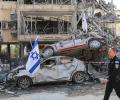
Iran fired around 200 ballistic missiles and drones at Israel on Saturday, June 14, 2025, causing widespread damage in communities in north Israel, killing three people and injuring dozens.
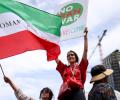
China and Russia on Sunday strongly condemned the United States air strikes on Iranian nuclear facilities, with China calling it a serious violation of the United Nations Charter that heightens tensions in West Asia, and Russia terming the strikes 'irresponsible' and asserting that they grossly violate international law, the UN Charter, and UN Security Council resolutions.
During a bilateral lunch with the Ukrainian President in the White House, Trump reiterated his confidence in facilitating an end to the ongoing war.

Prime Minister Narendra Modi emphasized the strong partnership between India and the UK, highlighting its importance for global stability and economic progress amidst global uncertainty. Discussions covered trade, defense cooperation, and geopolitical issues.

Talmiz Ahmad is a former Indian ambassador to Saudi Arabia, Oman and the UAE. In an interview with Aditi Phadnis, he says the disequilibrium in Iraq will continue to prevail. Ahmad also says there are indications that the US is now anxious to avoid intervening militarily in West Asia, and that this is the appropriate moment for Asia to assume responsibility for its own security. Edited excerpts:
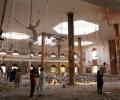
'But that was not our aim. Our objective was already achieved.'
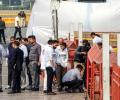
US Secretary of State Marco Rubio praises India's measured and professional investigation into the Red Fort car explosion, calling it a terrorist attack. The US has offered assistance, but acknowledges India's capabilities in handling the investigation.
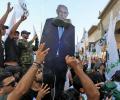
As the Iran-Israel conflict takes dangerous dimensions, support for Tehran comes from next door as Iraqi Shi'ite Muslims protest Jerusalem's attacks in Baghdad.
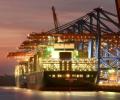
A year after a Hamas attack against Israel on October 7 and the ensuing Israeli invasion of the Gaza Strip, India's trade with most West Asian countries has largely escaped any major disruption, except with countries like Israel, Lebanon, and Jordan. However, repeated flare-ups of geopolitical tensions in the region continue to drive up shipping and logistics costs.
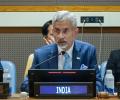
External Affairs Minister S Jaishankar has called on Brazil, Russia, India, China, South Africa (BRICS) to defend the multilateral trading system amid increasing protectionism and tariff volatility during a meeting of the bloc's foreign ministers in New York on the sidelines of the United Nations General Assembly session.

'IT companies do not have a large presence there either in terms of market and team. So, the impact of the war will be minimal. But West Asia is an emerging economy.'
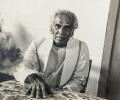
What appeared to be a generous act of friendship was, in truth, a manoeuvre within a much larger strategic game. The United States used the 1962 war not just to aid India but to test how far it could be pulled into the Western fold, points out Dr Kumar.

India will drive growth in the Asia-Pacific (Apac) region as the growth engine is likely to shift from China to South and Southeast Asia in the coming years, S&P Global Ratings said in a report on Tuesday. The rating agency's report projected China's growth to slow down to 4.6 per cent by 2026 from an estimated 5.4 per cent in 2023. India is likely to clock 7 per cent economic growth from 6.4 per cent estimated for 2023.
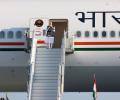
The Kananaskis gathering on June 16-17 is the Prime Minister's 6th consecutive participation in the G7 Summit.
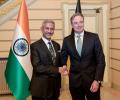
The era where nations thrived through rigid alignments is giving way to an age where the connective State defines power. For India, that era has arrived, points out Dr Nishakant Ojha.

Equity benchmark indices Sensex and Nifty tumbled in early trade on Monday amid heightened tensions in the Middle East after the US bombed three major nuclear sites in Iran. The 30-share BSE Sensex tumbled 705.65 points to 81,702.52 in early trade. The 50-share NSE Nifty dropped 182.85 points to 24,929.55.
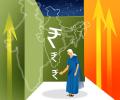
S&P Global Ratings on Tuesday upped India's GDP growth forecast for the current fiscal to 6.5 per cent, citing lower crude prices, monetary easing and normal monsoon, and said the ongoing geopolitical tensions are unlikely to put a "significant pressure" on the rupee or inflation.

Skipper Shubman Gill acknowledged that the choice between a spinner and an extra seamer for the first Test against South Africa is nothing short of a "conflict".
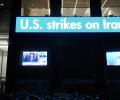
The opposition party reiterated the absolute essentiality of immediate diplomacy and dialogue with Iran.

Trump couldn't care less anymore about the Israeli demand for Iran's 'de-nuclearisation' and 'de-militarisation.' Trump pins hopes on a grand bargain with Iran as a partner in America First, argues Ambassador M K Bhadrakumar.
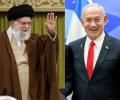
As per Israeli media, at least four people have been killed and several injured after an Iranian missile struck a residential building in Beersheba.
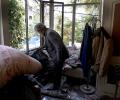
'The condition was getting worse here every minute'

'Pakistan has found itself in a favourable position after Operation Sindoor by appreciating the mediation as claimed by Trump and recommending him for the Nobel Peace Prize.'
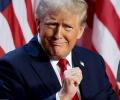
'Trump would like the war in Ukraine to be over, and that it would be weighing on his mind even before the Inauguration ceremony in January next year.'

'The background for the Saudi-Pakistan agreement is the fact that the regional security order has collapsed due to the Israeli attack on Doha.' 'The Americans have largely abandoned their security guarantee for West Asia and the region has no choice but to look at alternatives.'
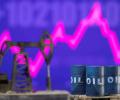
Brent crude oil prices can touch $150 a barrel (bbl) - up a whopping 103 per cent from the current levels - in the worst-case scenario if the Israel-Iran geopolitical tensions escalate, suggest analysts.
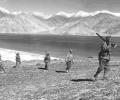
As India and China continue to face off across the Himalayas six decades later, the echoes of that earlier conflict remain unmistakable. The core of China's sensitivity lies not in maps or mountain passes, but in its perception of sovereignty over Tibet, points out Dr Kumar.
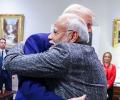
One must wonder whether Mr Modi's efforts to wine and dine the Big Two of today's world were seen as a sign of weakness rather than a proffered arm of friendship, points out R Jagannathan.
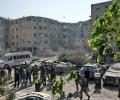
At the end of the day, for many worldwide, the ongoing mutual attacks between Israel and Iran would seem a contest devoid of any moral high ground and only a bout between two ordinary adversaries, one that nevertheless risks spinning out of control into a larger conflagration, notes Shyam G Menon.
 © 2026 Rediff.com - Advertise with us - Disclaimer - Privacy Policy - Sitemap - Feedback - About us - Terms of use - Grievances